A Single View of Marriage |
Biblical Sexuality |
'Christian' Books |
Missionary Kids |
Pet Peeves
Pornography: Confession, Healing, and Contention |
Respecting Women |
Single Notes
Snippets |
Spiritual Forces |
Tension Points |
'Wild at Heart'?
| Snippets (View in PDF) |
Anything but sin |
"Because I can" |
Business 101 |
Christianese |
Cloud computing |
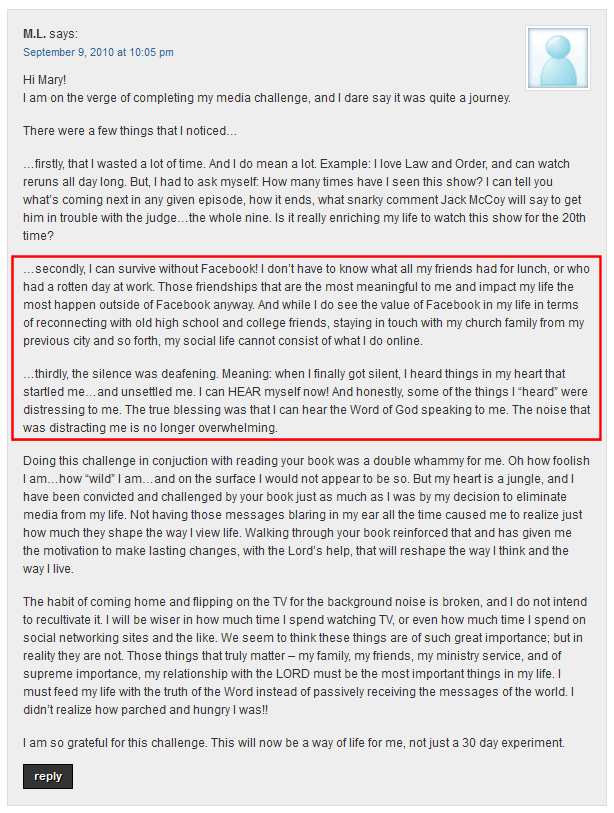
Facebook |
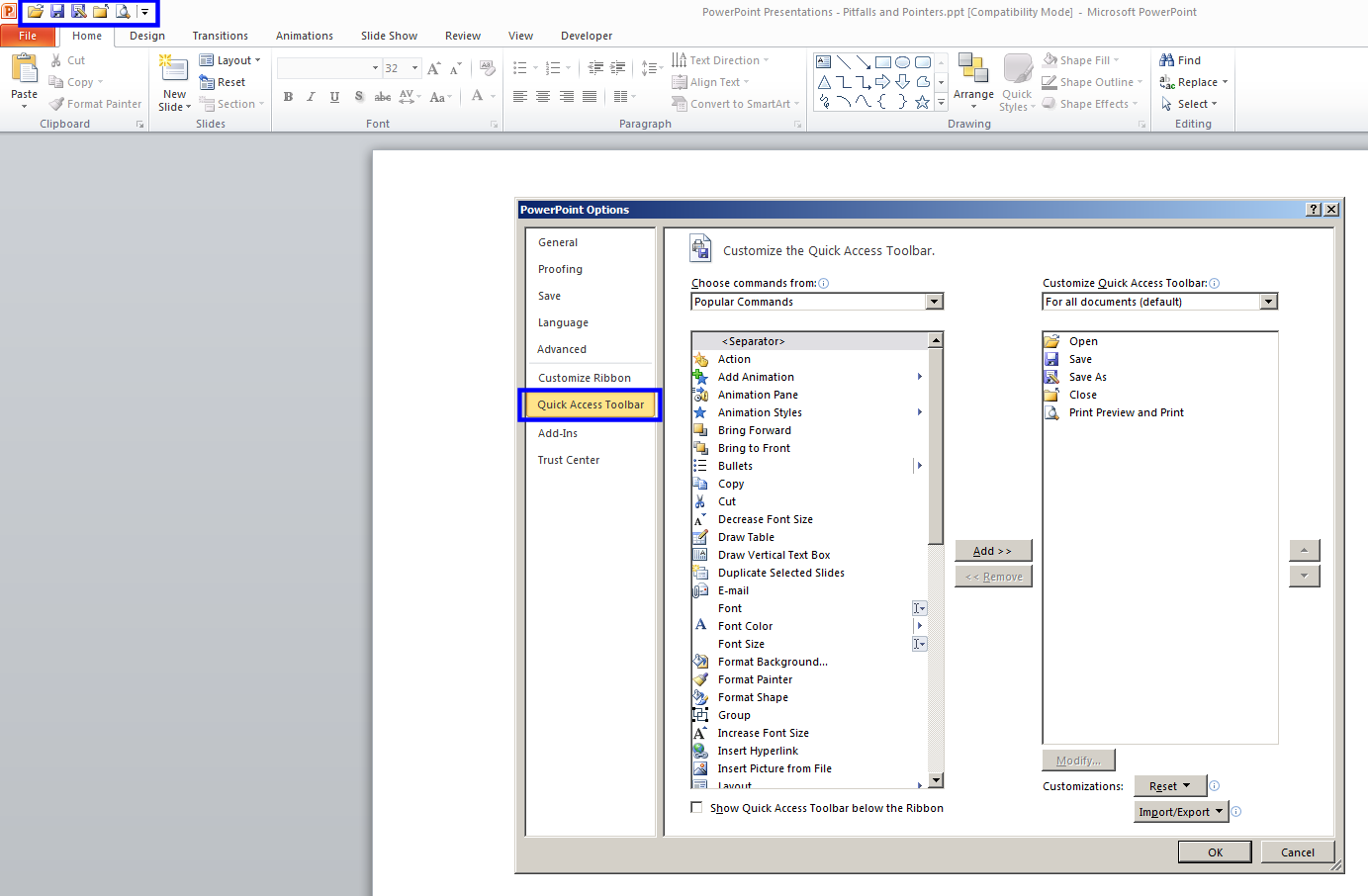
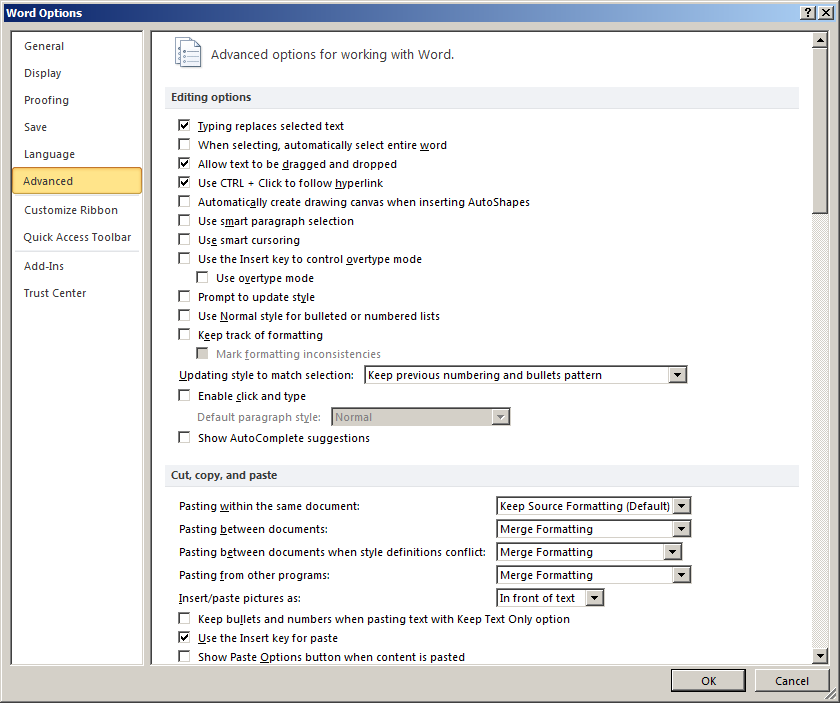
Flaws of the ribbon |
Media bots |
Millennials |
My message(s) to women |
Plastic Christianity
Surface conversation |
The danger of technology |
Too much information |
Windows 8: Epic fail. |
Windows 10: Your final choice. |
Words and connotations |
Worship vs. entertainship
Anything but sin
It really bothers me every time I hear someone—but especially pastors—use a euphemism or vague "fluffy phrase" to avoid using the word "sin" in their message—sounding more like an Army recruiting slogan than anything else: e.g. "God wants you to be all you can be for Him." God calls it sin, and demands both our confession and repentance. That settles it. Stop watering down the truth:2 Timothy 4:3-4 (NIV 1984): "For the time will come when they will not endure sound doctrine; but wanting to have their ears tickled, they will accumulate for themselves teachers in accordance to their own desires, and will turn away their ears from the truth and will turn aside to myths."
We live in a world that gives little to no thought or attention to logic and consequences; you know, asking the simple question: "What will happen if I do or say this, watch this, act this way, or buy and start using this?" Even simple logic and common sense are completely ignored. From technology to sexuality, we just don't care anymore. Blunt but ever-so-true, even the street language saying of: "Check yourself before you wreck yourself" is ignored. And we wonder why the world is in such a mess? Welcome to The Twilight Zone.
|
|
"In other words, Ubisoft did give Watch Dogs a graphic downgrade, and did so intentionally. The retail release was quite capable of looking every bit as good as the E3 demo, yet someone wrote the code needed to make it look worse. Despite these discoveries, Ubisoft PR rep Tessa Vilyn, in a tweet sent earlier this week, stood by her assertion that Watch Dogs had not been downgraded."
People who have recently repented of their sin and chosen to follow Christ pray in a very refreshing way—there are no overused expressions, clichés, colloquialisms, pretenses, or vague meanings in their words. Just the specifics of what they're facing, how they feel, and what they need. Having grown up in a Christian home, and being around Christians most of my life, I value what these new believers don't have: Christianese. I would define it as flippant (but sometimes well-intentioned) personal opinions, platitudes, pat answers, unbiblical euphemisms, vague catch-phrases, or rationale used to explain, avoid, or suppress discussion about truth. There's a reason why GriefShare classes warn against fellow believers using cutesy quotes that fail to answer or address any real questions or heart-wrenching pain that believers have. In other words, 'cute' little answers that conveniently sweep ugly realities under the rug, instead of simply being honest about the bewildering reality. One of the most practical pieces of advice I've ever received was from Carl Reichandter, who told our class that, when someone is grieving, the best thing you can do is be quiet, give them a hug, and cry with them—no Christianese phrases or quotes. It made sense back then as the person giving hugs, and even more sense now as the one who was hugged in the moment of loss.
Here's a perfect example of Christianese quotes reminiscent of 'Sphinx' in the movie Mystery Men:
"What should matter most to us as Christians is not our faith in Christ, but the Christ of our faith."
"God never withholds from His child that which His love and wisdom call good. God's refusals are always merciful—severe mercies at times but mercies all the same. God never denies us our heart's desire except to give us something better." — Elisabeth Elliot
Granted, most believers don't wear masks because they're hypocrits; they wear them because the church isn't a safe place to take them off. But the longer you've been a Christian, the easier it is to absorb and repeat Christian "lingo" in an attempt to sound eloquent to those around you. I realize it's difficult to think of new, accurate words and terminology when praying for the same things year after year, and prayer in a public context affects what we're understandably comfortable praying about, but we should always be praying from the heart, and directly to the Lord:
"When you pray, you are not to be like the hypocrites; for they love to stand and pray in the synagogues and on the street corners so that they may be seen by men. Truly I say to you, they have their reward in full. But you, when you pray, go into your inner room, close your door and pray to your Father who is in secret, and your Father who sees what is done in secret will reward you. And when you are praying, do not use meaningless repetition as the Gentiles do, for they suppose that they will be heard for their many words. So do not be like them; for your Father knows what you need before you ask Him." — Matthew 6:5-8 (NIV 1984)
And for the times when we don't want to hear the biblicly-correct answers, it's not because we don't believe it's the truth; it's just that sometimes we need to hear that someone else struggles with it.
 |
"Don't store your valuable data on the cloud where hackers can break in and steal."
As it becomes increasingly more mobile and prevalent, technology is also becoming more invasive and controlling, as monitoring, reporting, access, and manipulation of information and data increases exponentially—especially in combination with "the cloud" (a euphemistic term for "handing over control and ownership of my information and how I run my business [read the fine lines] to someone who I can't inherently trust"). In addition, advertising and its use of pornography (especially "soft-core" porn aimed at all of us) are a massive problem. Personal financial and medical electronic information are subject to both governmental and corporate control and manipulation, not to mention hackers and identity thieves. The ominous thing about these trends is that they are growing bigger and faster than anyone can accurately predict, and most of it remains in the hands of people who have no desire to see it used in an objective or ethically responsible way, but rather for personal, corporate, and governmental control, power and financial profit.
Which location do you think is more likely to be hacked or held for ransom? A large online corporation storing millions of users' data in "the cloud", or my own removable device with encrypted data? Which one do I completely own and can trust? Which is easier and faster to clean up if compromised? Which one do I have more control over? Ask just one person who has been the victim of identity theft what they think about the cloud...
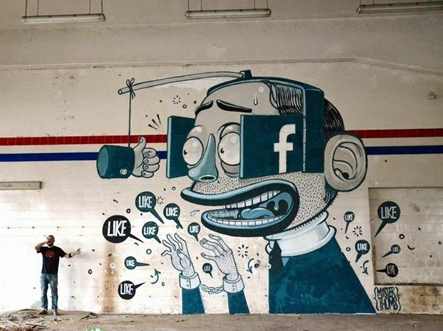 A picture is worth a thousand words |
Have you ever given any thought to the ramifications of using Facebook (a.k.a. "Failbook" or "Life Invader")? No? Take a look at this list. Like cell phones and other forms of technology, Facebook connects you to people. But besides potentially wasting hours of time every day on arguably insignificant minutia, there are dangers that most people either are not aware of, or just don't seem to care about.
When you use Facebook, you are creating an intricately detailed profile (saved article) not only of yourself (your likes, dislikes) but who your friends are, which organizations and political parties you're affiliated with, etc. Facebook tracks and owns every tiny piece of that data. Ever heard of data mining? How about increasing governmental control, intrusion, and ever-increasing globalization, not to mention hackers and identity theft? You are using their website, their services, and nothing is deleted from their system once you put it there; data may be removed from the interface, but not from their system.
It also creates a dependency. Ever stopped to calculate how many hours a day you spend on Facebook posting and absorbing information? With numerous companies and organizations catering to the Facebook "movement," an account with Facebook is rapidly becoming more of a requirement than an option. You may say, "But so many people are on it, and there's safety in numbers!" Ironically, that's why it's so dangerous:
Flaws of the ribbon
Microsoft touts the ribbon "interface" as the "modern way to help users find, understand, and use commands efficiently and directly—with a minimum number of clicks, with less need to resort to trial-and-error, and without having to refer to Help." I vehemently challenge that assumption, and here's why. The three biggest philosophical problems with the ribbon is that it: Some additional problems: "List" GUIs used in conjunction to the ribbon are a very lazy approach to interface design. While they are easy to create since they require little time for layout, they become a 'dumping ground' for options and preferences. In addition, they rely heavily on vertical space while completely ignoring extra horizontal space the majority of users now have due to the prevalence of widescreen monitors. What constitutes a "media bot?" My personal definition is anyone who cannot voluntarily disconnect themselves from one or more forms of connective technology for more than a day. Media bots are typically people who buy and use the latest technological device simply "because they can," "because it's cool," or "because everyone else is" without a truly valid, practical need for it. Examples: checking your e-mail every fifteen minutes or less or text messaging when you should be paying attention to people or your surroundings. Personally, I'm trying to disconnect myself more from the web, and spend more time in the real world; admittedly, not an easy task! David Livermore explains How Smart Phones Lower CQ. Digital Nation (10m 50s into the video) found that "...people who claim to be multitaskers with information actually are significantly slower when switching than when doing the same task consistently. Multitaskers are terrible at every aspect of multitasking:" Some additional thoughts on this from Merritt, a lady who says: Turn off your gadgets and let's talk face-to-face and digitaljournal.com: Op-Ed: Disconnected in a technology-connected world. Ever heard someone talking about Millennials? They usually go to great lengths throwing out hypotheses and statistics, trying to purport a special formula for communicating or interacting with them, making it sound like they're from another planet. Please. It's time the hype and generalizations stopped. The truth is, every generation has some differences, and Millennials have dreams, problems, and a sin nature just like everyone else. We are all in need of God's grace.
The next time you question where the church is, take a good hard look at the faces of the people around you during the service, and try telling me the church is healthy. Where is our joy and enthusiasm? Our pews are full of the living dead. Living, because Satan knows he can't permanently kill the church; but dead because we have as much life. The church has a plastic mask problem. Why are they worn? For some, it's a "keeping up appearances" buffet Christianity that worships sugar-coated, comfortable topics while refusing to talk about the real, rubber-meets-the-road life and faith issues and be relevant to struggles that all of us are facing. Or refuses to stand up for biblical truth because "it might offend someone". That can hypocritically quote Scripture without even trying to live it. That's intentionally ignorant about biblical doctrine, and instead touts personal opinions and fluffy hearsay over Scriptural truth. That wears a mask and insinuates that "I have no sin, no questions about my faith; no struggles."
For others, it's because—sadly—it's not safe to take them off; running the risk of judgment and criticism from others. Or perhaps too painful to reveal wounds that run deep. Regardless, at the end of the day, we're more concerned with saving face than saving souls. We attend church, and pretend that everything is just fine, while living a lie. As Jessica Harris notes:
"What has happened is we've bought into this lie that Christians are supposed to be perfect. So, we're really good at throwing the book at each other, judging each other, and hiding our own pain and need. Then the walls start caving in around us, and we still put on the face acting like life is just perfect because we have Jesus."
I've been as guilty of this as anyone I know. Am I truly repentant, and continually praying for a repentant heart? Am I willing to be vulnerable and uncomfortable? Do I have compassion for fellow believers? Am I moved to pray for them? Am I willing to take the time to listen, and do so without judging and criticising? Am I willing to admit to my own sin and struggles? Real, biblical Christianity admits failure and shortcomings, isn't afraid to ask questions that we don't have answers for, and be vulnerable with others in the desire to live out every truth of Scripture—even if that vulnerability comes with criticism and judgment from others. It's worth every second of living.
There's nothing inherently wrong with them, but I've had more than my fill of fluffy, worthless surface conversation (read: insignificant minutia) and forced, formal interaction/events, where nothing of value is ever shared or discussed. When does this happen? Typically, anywhere you have more than two (possibly three) people. The dynamics of conversation dictate that, unless you have a very unique, safe setting for it, the more people you have, the more meaningless and superficial the conversation becomes. For obvious reasons, people simply don't feel safe sharing in larger groups.
Why am I so vehemently opposed to it? For husbands and wives (or those who are dating), meaningful, intimate heart-to-heart discussions are merely moments away; so for them, occasional superficial conversation is fine. But for those like myself who are single even into their 40s who have never known intimacy, it's all most of us have ever had access to. Please; no more.
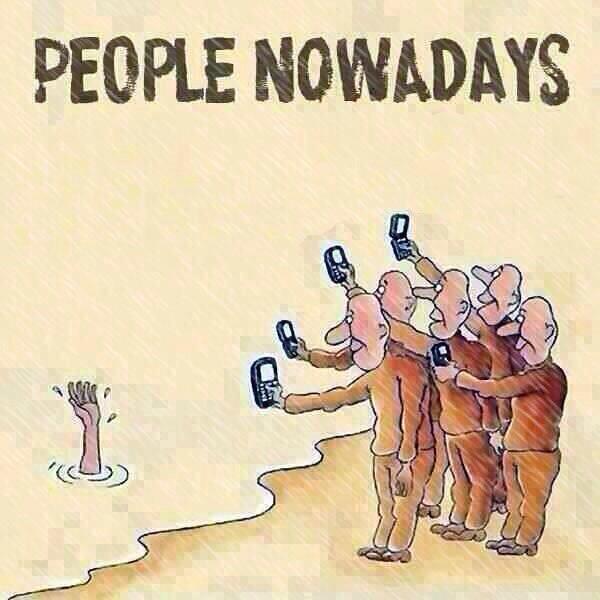 |
In our eagerness to embrace the newness of technology, we always ask, "What can it do?" Few are asking the only question that really matters: "What will it do?" Sometimes, nature itself says "Enough!". And if science fiction teaches us anything, it should be that we cannot be too careful where technology is concerned. From Digital Dementia (the deterioration of brain function as a result of the overuse of digital technology, such as computers, Smartphones and Internet use in general) to growing dehumanization (extra link 1, extra link 2). We rightly understand that only time can give us a complete picture, but something is very wrong when our nearsightedness and lack of concern for the future—let alone the present—lead us to measure the ramifications of technology by the damage it has already done:
As someone wisely noted on techreport.com:
"And you're right that passwords stink, and that we have to have so many of them. But I disagree with you on one point: biometric security that can be guaranteed is not a goal we should strive for. First off, the only guarantee in the tech security realm is that whatever lock you make, eventually it will be broken. But besides the snide remark, bio security doesn't seem likely to be the panacea everyone hopes for. You only have one unique eye/iris pattern and one unique fingerprint. And when those are digitized and stored in a database that gets stolen or hacked into (and given our general ability to secure networks and databases, it's only a matter of when, not if) then what? If you think it's hard to change a password, try changing a fingerprint or iris pattern...the devil is in the details..."
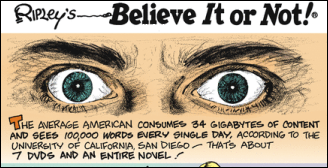 |
Ever feel like you're drowning in news, ads, biased opinions, and useless information and you just want to pull the plug on it all? Let alone knowing who you can really trust? Stores, restaurants, schools, hospitals, airports, even directly-in-your-face ads above the urinal on the wall in mens' rest rooms constantly bombard us and invade our lives. Have you ever stopped to think about how ridiculous the amount of information is that you see crammed into a major news network channel? Live 24/7 discussion/reporting, overlaid with constantly scrolling and updating world news ticker-tape. I find myself disconnecting more and more from media, and becoming more cynical and discerning about what—and how much—I see, read, or hear (as much as I have control over). It's just too much information. As people, we were never created to ingest or be subject to this, especially not at these extreme levels. It's time to start pulling plugs.
Burger King: "Have it your way."
Microsoft: "Have it our way. Or else."
Microsoft has an attitude problem. Until they admit that they failed epically with Windows 8, and stop acting like a stubborn little brat, they have no hope of regaining any respect from most of their user base. Why? Customers don't like to be ignored, let alone coerced. It would be like Burger King discontinuing the Whopper because it's "old and out of style now" and getting angry at you for wanting it back.
What Windows ME did to stability and reliability, Windows 8 did to the GUI. It is a preposterous oversimplification (read: pre-school) of the user interface at the expense of intuitive, time-proven GUI logic and convention. Using flat, solid colors/blocks, and sliding elements around on-screen is Fisher-Price; not professional. It's also ugly. Like Margaret Hamilton ugly. I want a professional, consistent, aesthetically pleasing and intuitive GUI designed for a mouse and keyboard; not a lazy-butt "Hello Kitty" design somehow(?) supposed to magically make me worship touch screens and a dumbed-down GUI. While some legitimate improvements were made under the hood (e.g. faster boot time by weeding out superfluous clutter—that should have been done decades ago—and built-in support for USB 3.0), Microsoft's "fashion design team" completely trashed most, if not all, of the carefully learned and time-proven human interface/GUI design conventions developed over the last twenty-plus years—elements that do not change because they are rooted in real-world logic; not ignorant marketing whims. GUIs are not the fashion world; and even then, the masses buy and wear clothing that meets their needs for comfort and sensibility. Change for the sake of "we want something new" = royal shipwreck.
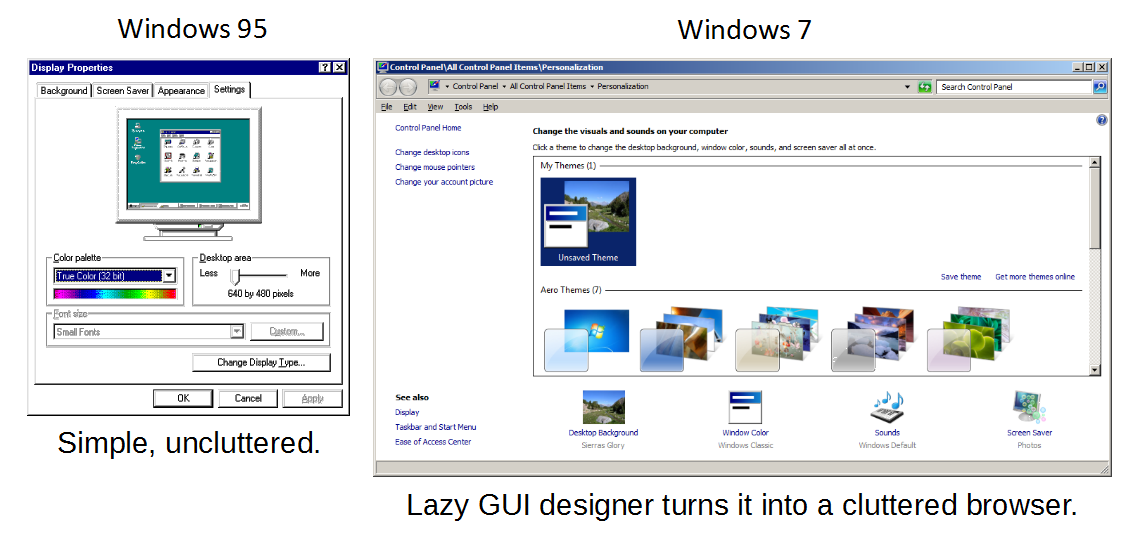
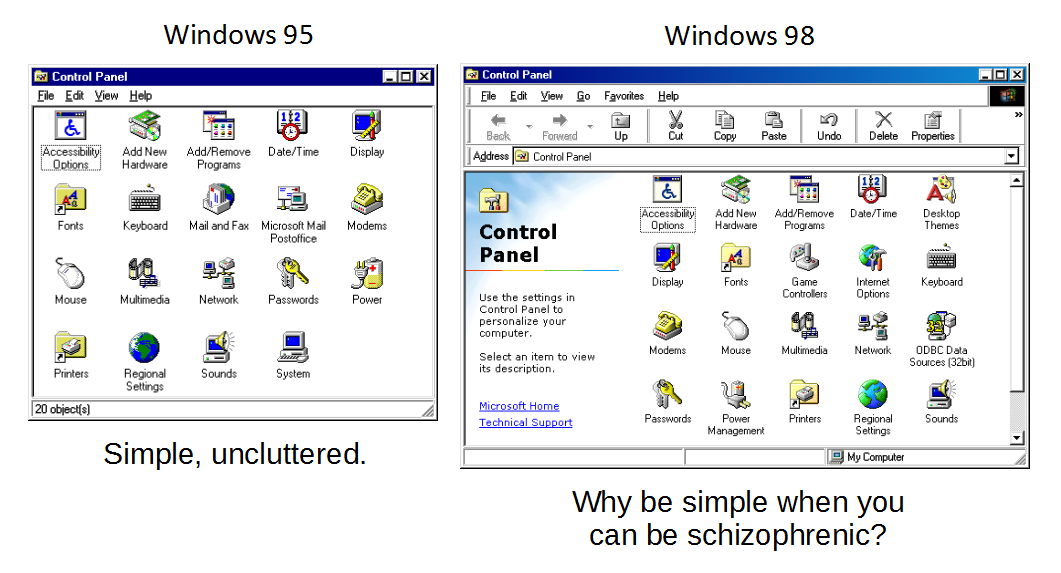
Even as good as Windows 7 is, its GUI already looks like a schizophrenic OS trying to be a web browser (the trend of which started in Windows 98 when Microsoft began moving OS elements into Internet Explorer in an aggressive attempt to promote it over Netscape). Got news for you, Microsoft: there's a big difference between the two, and by the way, I already have a browser. Remember their dictator-like attitude reflected in their "vastly improved" ribbon toolbar? It's way past time they hired people who actually know what a real OS and GUI are, how they function, and what they're supposed to do; and I'm not the only one who feels that way:
As another user noted:
"Every time I tried something the new "Metro" way, I kept asking myself "is this better than the old way of doing it?" and the answer was almost always "no, this has been seriously compromised just to make it compatible with fat fingers on a tiny touchscreen." Microsoft are directionless and unfocused at the moment. Until we stop going to work in offices and sitting at a desk with a keyboard and mouse, that is what they need to concentrate their OS efforts around, and Windows 8 is not even in the same ballpark."
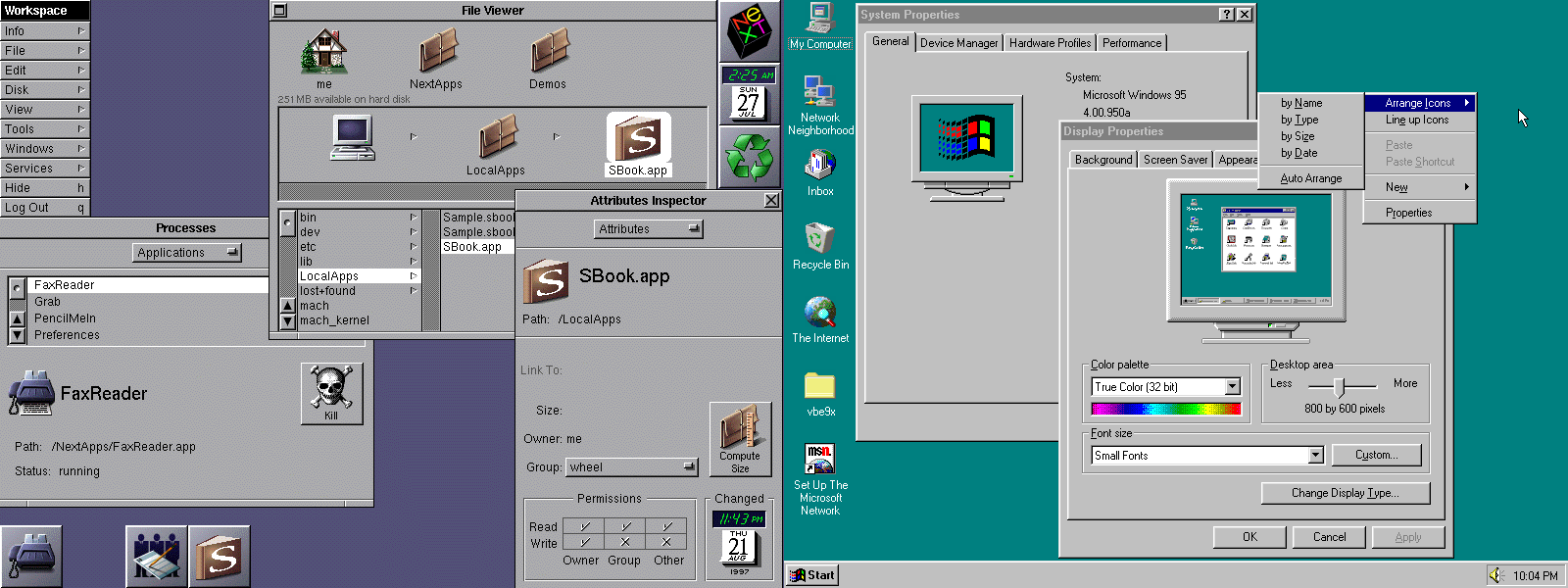
Why does this matter? Again, there are significant design and functionality differences between GUI elements which are static in an operating system, vs. a web browser, which by nature is dynamic—requiring adaptability for the Internet. Microsoft (although they clearly stole the basic design of the NeXT's GUI) implemented Windows 95's GUI in a singularly thorough and consistent way throughout the OS, presenting a clean, simple, and intuitive user experience. The problems began when they introduced inconsistency in Windows 98 by mixing the GUI elements of a web browser (e.g. links instead of buttons, URL gadgets in Windows Explorer, etc.) with that of Windows 95. This was further exacerbated throughout Windows XP, Vista, and 7. Instead of resolving this inconsistency in Windows 8, they discarded all previous GUI elements (minus their Office 2010 line) and forcibly introduced two new GUI 'philosophies': the Fisher-Price flat, solid-colored, sliding blocks; and overly minimalistic windows, buttons, and icons that lacked any professional polish (3D highlighting) and intuitive borders. This move intentionally spurned time-proven GUI design. Clearly-defined borders around GUI elements provide clarity and functionality by removing confusion as to what each GUI element is and where they start and stop. In addition, when you consider that 3D highlighting has long proven itself in providing both an attractive and realistic-looking aesthetic appeal (giving it a professional, polished look), you simply cannot say the same for Windows 8.
Windows 10: Your final choice.
Microsoft clearly failed with Windows 8. Numerous objective reviews (let alone sales figures) reflected that simple truth, and massive user rejection dealt Microsoft a blow that they didn't like: someone disagreed with them and their direction for Windows. Queue tantrum.
But instead of repenting and learning from their most embarassing failure since Windows ME, Microsoft's new strategy is simple: bait and switch users to Windows 10, implementing the removal of user choice AND voice. At which point they now have a blank check and full freedom to do anything they want to, with, and via, Windows—without any user voice to say "no" at any time (can you say "data mining"?), and most importantly, no "withholding my purchase" from software I don't agree with or dislike—the biggest vote of all that remains the only means of accountability Microsoft heeds.
The fact that Microsoft is literally giving away Windows 10 for a full year should be a big enough red flag on its own. Quality sells from word of mouth alone. But their tactical use of content exclusivity (DirectX 12 only available for Windows 10) to bait users is even more telling. Microsoft has already stated that users have no choice in accepting whatever "updates" (problematic or not) are shoved down your throat pushed out to you. It also means if Microsoft decides to start dropping ads into Windows 10, or refusing to tell you what's in Windows 10 updates, you have no way to switch it off. Or they can do what Facebook is already doing—using facial recognition and your personal info for advertising/data mining purposes. Implement advertising in Windows? No problem. Snooping on users? Sure. Remove the start menu and restore tiles? Go for it. And PC World warns that: "Windows 10 still packs Windows 8's contentious Metro apps and Microsoft services."
No repentance means no attitude change. Welcome to Windows 10:
As Christians, we need to be very careful which words we use, because each of them carries connotations. As an example, homosexual activists have been using—and promoting the use of—the word "partner" or "companion" instead of words like spouse because it subtly removes the connotation of a husband-wife relationship; advancing their agenda while denigrating natural, God-designed one-man, one-woman marriage. Have you ever considered how ironic it is that the word "feminist" brings to mind starkly contrasting images and meanings compared to "feminine" (do an image search on the web to see what I mean). Again, words carry meaning, and meaning matters. Another example are slang words we've adopted with roots in sexual innuendo or crude references: e.g. "screwed up," "bone up on," "crap" etc. We are commanded in Scripture to keep our words and conversations beyond reproach:
Ephesians 5:3-4 (NIV 1984): "But immorality or any impurity or greed must not even be named among you, as is proper among saints; and there must be no filthiness and silly talk, or coarse jesting, which are not fitting, but rather giving of thanks."
Ephesians 4:29 (NIV 1984): "Let no unwholesome word proceed from your mouth, but only such a word as is good for edification according to the need of the moment, so that it will give grace to those who hear."
Luke 6:45 (NIV 1984): "The good man out of the good treasure of his heart brings forth what is good; and the evil man out of the evil treasure brings forth what is evil; for his mouth speaks from that which fills his heart."
I used to argue: "But why should I be so paranoid? I need at least some gray areas—holiness is just too restrictive!" It's not paranoia; we are to have zero gray areas in our life. It means we finally stop making and believing excuses about our sin.
The dictionary's definition of worship is: "reverence offered a divine being or supernatural power; also: an act of expressing such reverence."
It's interesting that, even according to a secular dictionary, reverence is the definition of worship. Some thoughts on this:
| Comments? |